Topics: Retrocomputing

The other day I was thinking about the first communities I found online and, perhaps tangentially, to what degree they influenced the amount of therapy I now require to function normally as an adult. Our family's second computer came from Sam's Club. It was a 386DX with Windows 3.0 but my inner nerd would have nothing to do with cheerful bit-mapped color schemes, preferring instead to exit to MS-DOS and do all necessary computing and gaming from a command prompt and text-based GUIs. Hardware-wise, it looked and felt cheap. The machine was less reliable than the cardboard box it came in. It was a Packard Bell and if you were to read this paragraph to anyone who was into computers in the 1990's, they will hear that name and then simply close their eyes and nod quietly in sympathetic understanding.
(Nostalgic Modem Noises)
Most importantly, it came with a dial-up modem. My mom's series of reactions when I told her I had plugged our new computer into the telephone line were as follows:
- "Huh, you can do that?"
- "But why would you do that?"
- "WHAT HAVE YOU DONE AND HOW MUCH DO WE OWE?!"
Now in my defense, as a semi-rebellious teenager eager to experience literally anything outside languid rural Midwest life, I often leaned hard into the practice of begging forgiveness in lieu of asking permission. Sometimes I even got away with it.
To give a better idea of the timeline and circumstances, the Internet as we know today it only kind of existed in the early 90's. There was email, there were message boards, file exchange programs, remote login to other systems, real-time chat (IRC) and so on. The web was new and promising and free of ads but not at all the main attraction just yet. And unless you lived in a city or attended a university with a well-funded technology department, the Internet was probably not yet accessible to you. Or for the purposes of this article, me.
But bulletin board systems (BBSes) had been around since at least the early 80's. Maybe earlier, I'm not sure. These were computers connected to phone lines. When you called a number with your computer, the other computer answered, and you could interact with whatever software the sysop (system operator) had set up. Usually these contained at least public and private message boards, but many also had places where you could download and upload files, chat in real time with others (if the BBS had multiple lines), or play games.
How I came upon the early essentials necessary to connect our computer to other computers is a complete mystery to me at this point. I didn't know anyone else with a modem and my school's computer situation was about a decade behind: "computer" classes were really typing classes taught by a cartoon cat named PAWS on Apple IIs. Back at home, at a bare minimum, I would have needed a terminal program to dial up and interact with another computer. So did I have one already or did I grab one off a shareware floppy that came in some magazine? Where did I even find the number of the first BBS (bulletin-board system) to call?
What happened next is easier to remember. I racked up quite the collection of informative text files from that first handful of BBSes I found, which generally included programming guides, hacking e-zines (Phrack!), some anarchy-type content, and rather entertaining but unhinged conspiracy theories. And of course, where to find more BBSes. I also clearly remember downloading as much software as I could get my hands on. Plenty of development tools, different modem terminal programs, and scads of DOS utilities. I learned a lot in a very short amount of time about BBS software, doors, Kermit, X/Y/Zmodem and ZIP files. It took about two hours to download enough data to fill up a 1.44MB floppy disk over a 2400 baud modem. (Eventually I managed to con my mom into buying a 14.4kbps modem a little bit later. I still have no idea how. Maybe because we had a free trial of Prodigy and that needed a faster modem to draw all the fancy vector graphics?)
But that all came to a swift end when my mom got the phone bill at the end of the month. In those days, local calls were free, long distance calls cost money. You paid by the minute and it was not especially cheap. The problem was, we lived in a town so small you could just about trip over it on your way to somewhere interesting, so everything outside a 1.5-mile radius was long distance. I never heard what the monetary damage was, but she did state in no uncertain terms that it would not be allowed to happen again.
1-800-YOU-NERD
(Don't actually call this, I don't know where it goes.)
One of the files I happened to grab was a list of toll-free BBSes. Or as we'd say back before more toll-free codes were added, "1-800 numbers." I didn't know exactly what I would find at these numbers, but that was a big part of the appeal. The first list I downloaded was TB01-94.TXT by Doug Schneider. Here are some others that I have in my collection from around that time frame:
- TB06-96.TXT - Newer version of "The Best 800 List", also in in the wayback machine. (Click on the ZIP, not the TXT.)
- ECBALAM.TXT - "1-800- BBS'S ACROSS THE US" by Bryan Balam - Date Unknown
- BBSWORK3.TXT - "BBS's That Actually Work!" by Kevin Ardoin - August 1994
- BBSWOR41.TXT - "BBS's That Actually Work!" by Kevin Ardoin - December 1994
- TRANSBBS.TXT - "TRANSPORTATION-RELATED ELECTRONIC BULLETIN BOARD SYSTEMS (BBS)"
I have a very clear memory of trying numbers in some semi-random order, crossing off the ones that never answered and highlighting interesting ones to come back to later. I wrote notes next to some. The crossed-off lines outnumbered the highlighted lines 10-to-1 at least. If I ran into a busy signal, it would sometimes be quite a while before I came back to it. It turned out that these toll-free computer systems came and went faster than people could update and pass around the text files. The vast majority of the numbers I called responded with any of:
- Endless ringing
- Busy signal
- "DOO-BE-DEEP The number you have dialed is not in service. Please try your call again later."
- Fax machine sounds (similar to, but audibly different from modem sounds!)
- Someone picking up and answering, "Hello?"
When a modem answered, there was still a fair chance that it wasn't anything useful to me. Many did not automatically detect your modem speed, so good ol' "2400 8-N-1" was not always a given and the listings were not always super accurate or up to date. Lots of these toll-free numbers required a pre-arranged login to get anywhere fun. I couldn't even tell what many of them were. Either just a prompt that didn't respond to anything sensible like help or dir, or acronyms/names that I couldn't decipher. (I wish I had kept logs of my terminal sessions, figuring them out would be a lot easier now!) A few numbers would let you register an account, but the content inside tended to be extremely boring to a teenager without disposable income. Very little about computers, music, video games, or chatting with other random people.
That is, until I found BARK.
Ephemeral Surrealism
It turns out BARK was a toll-free electronic message board where teenagers were encouraged to hop on and gab about teenage things. It was a little hard to believe that something like this existed among the sea of non-profit and government-related toll-free BBSes. To the point that when I woke up the next morning, I was beyond 100% positive it was just another one of those crazy dreams you have where you accidentally luck into something amazing that changes your life forever, only to then wake up to the cold gray reality of your previous existence. But I sat down at the computer again later in the day to resume my computing activities and found that this time my own brain was not actively trying to crush my hopes and dreams. For a change.
Unfortunately I kept little evidence of my time on BARK so most of this is from memory, corroborated by the remarkably few sources I could find on the modern web. These are some things that I do remember. Some with a high degree of resolute certainty and some not.
-
When you signed up, you had to answer a few basic questions such as how old are you, what kind of music you listened to, what was your favorite TV show, etc. Afterward, BARK would "verify" you by calling you back on the number you provided. I had to quickly figure out how to configure my computer to answer the call and make sure nobody else in the house answered the phone before the modem did. And come up with a good explanation for my mom as to why she shouldn't answer the phone, which was by far the bigger of the two concerns.
-
A lot of the users had signatures with funny sayings (taglines) in them. Writing and collecting funny taglines became something of a brief sub-hobby for me at one point.
-
I feel like BARK only had message boards. Maybe a file section. I don't remember there being any games to play, real-time chat, or anything other typical bonus features of BBSes at the time.
-
I think I found BARK while it was popular, but it got more popular soon after. Eventually, it got to a point where it would take hours of re-dialing until I connected (if I connected) and even then, there was a time limit before they booted you off to free up the line for someone else. This wasn't nearly enough time to catch up on popular boards and compose replies, so you were more or less forced to use QWK. When you connected, you could download a file containing all of the new messages that were posted since you last logged in. You would then disconnect, read the messages offline, maybe write some replies, and then upload those replies the next time you logged in.
-
The admins did their best to keep behaviour in line with the rules, but there was just entirely too many messages to proactively police. I encountered flame wars for the first time. Bans and deleted threads were very common. I tended to avoid the busiest boards (and their weird drama) and mostly stuck to ones related to computers and video games.
At some point, the admins posted an announcement that funding for BARK was being withdrawn and the BBS would shut down soon. A lot of us were understandably very upset by this. This was actually the first time I learned that BARK was run by PolyGram, the record company.
For a few months after BARK closed, I kept in touch with a couple other BARK users and we would snail-mail each other floppy disks back and forth to share games, fonts, misc software, wallpapers, and whatnot.
Threadbare History
While trying to piece together BARK's history, it became apparent that there is very, very little information about its existence left on the modern web. Pretty much just a few Reddit threads and very brief mentions of it from Parker Reilly, the guy who created and managed it. The Internet archive has a well-OCR'd collection of Boardwatch Magazine that doesn't have anything about it. Even the fact that there were even toll-free BBSes at all seems to have been largely forgotten. But here's what I've able to piece together.
The BARK BBS was conceived as a market research tool by the record company PolyGram. Someone with the authority to spend money at Polygram theorized that the current generation of teenagers with access to computers likely also had disposable income to spend on music. Instead of placing random bets on which invidual artists or genres would be popular, why not ask the kids themselves? Or better yet, set up some place where they can gather and discuss their musical tastes with each other and chat about upcoming indie bands. Then simply read what they said to discover the hot new trends in pop culture and music. Or at least that was the idea.
Oh, and since long-distance calls were fairly expensive, why not give it a toll-free number?
This Reddit post is a fairly personal first-hand account from Max, the guy who was the BARK sysop for a good percentage of the time it was online. It's well worth reading the whole thing but here are a couple highlights:
Bark BBS was some executive’s idea at Polygram Records for which we ultimately worked. Of course, I knew Polygram as they were publishers of many of my favorite rock artists. But what was the idea behind Bark? Parker explained that Polygram wanted to do marketing research through Bark and find out what young kids of high-school age wanted to listen to and what kind of music they were going to buy, so that Polygram could produce such artists and sell the records. At the moment the strategy was not very well defined and Parker was the chief editor with the job of running Bark and another guy was joining soon to be the marketing director.
Max continues:
So what did I do initially? We had an 800 dial-in number and four modem lines anyone could dial into. Parker had previously created relationships with many high schools across the country and in each school there was supposed to be a “representative” who would communicate with other representatives from different schools about pop culture, music etc. and then relay everything to his fellow students at the school. It was going to be a beautiful community of children all across USA and Polygram would know what their tastes in music are before other labels discovered the artists kids wanted to buy records of. I think they also tried publishing a magazine for the school kids, but probably one one or two issues actually came out as far as I remember.
BARK initially ran 4 instances of the PCBoard BBS software on a single MS-DOS machine (one instance per line) but was upgraded over time until eventually they were running an unspecified Mac with a "fault-tolerant" (possibly RAID-1) 2GB drive and 56k modems. From what I can tell, they got up to at least 16 phone lines, maybe more. Max goes on to describe how the board eventually devolved into barely-contained chaos until PolyGram finally realized they weren't getting the insight they had hoped for after approximately two years and pulled funding.
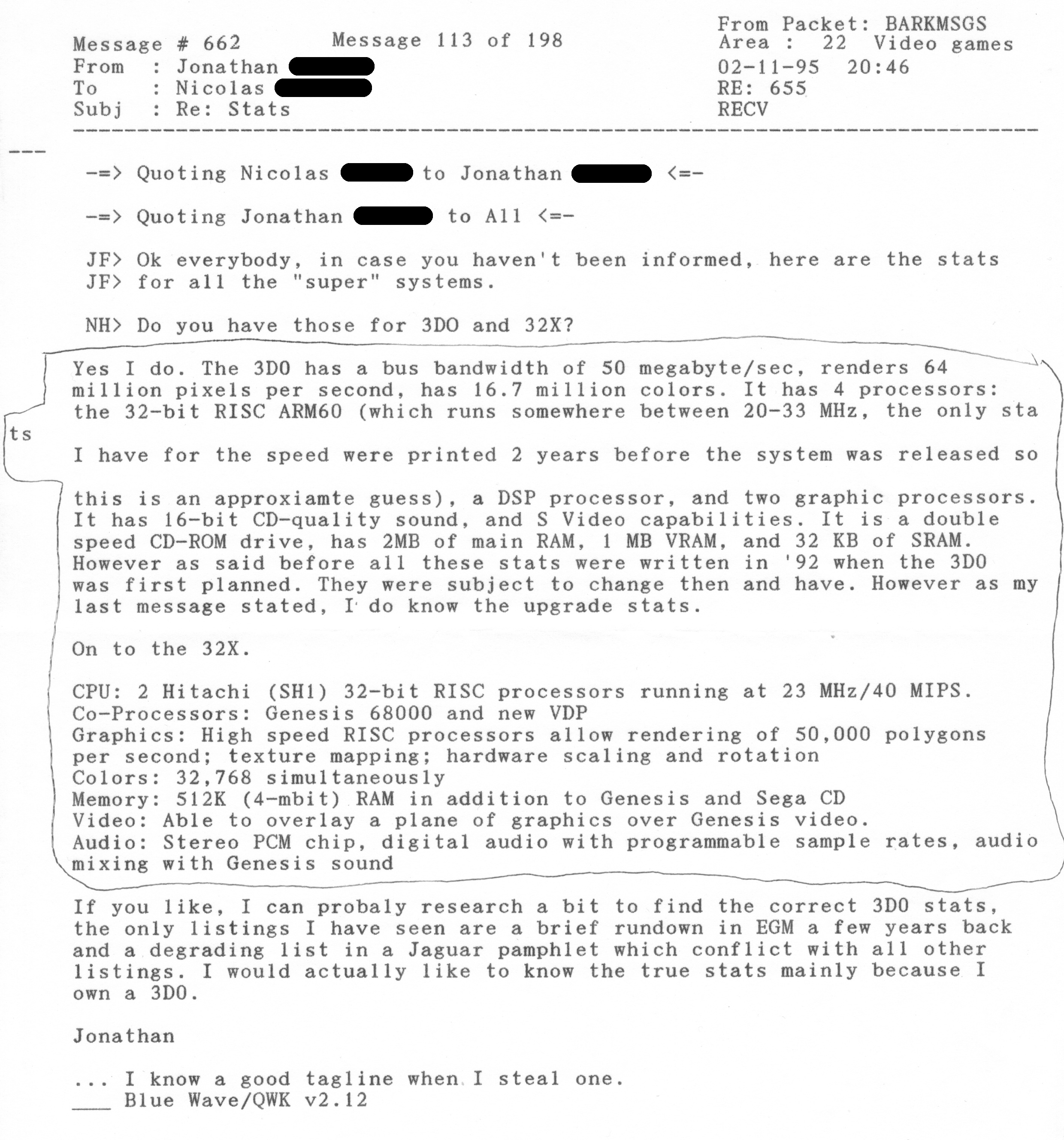
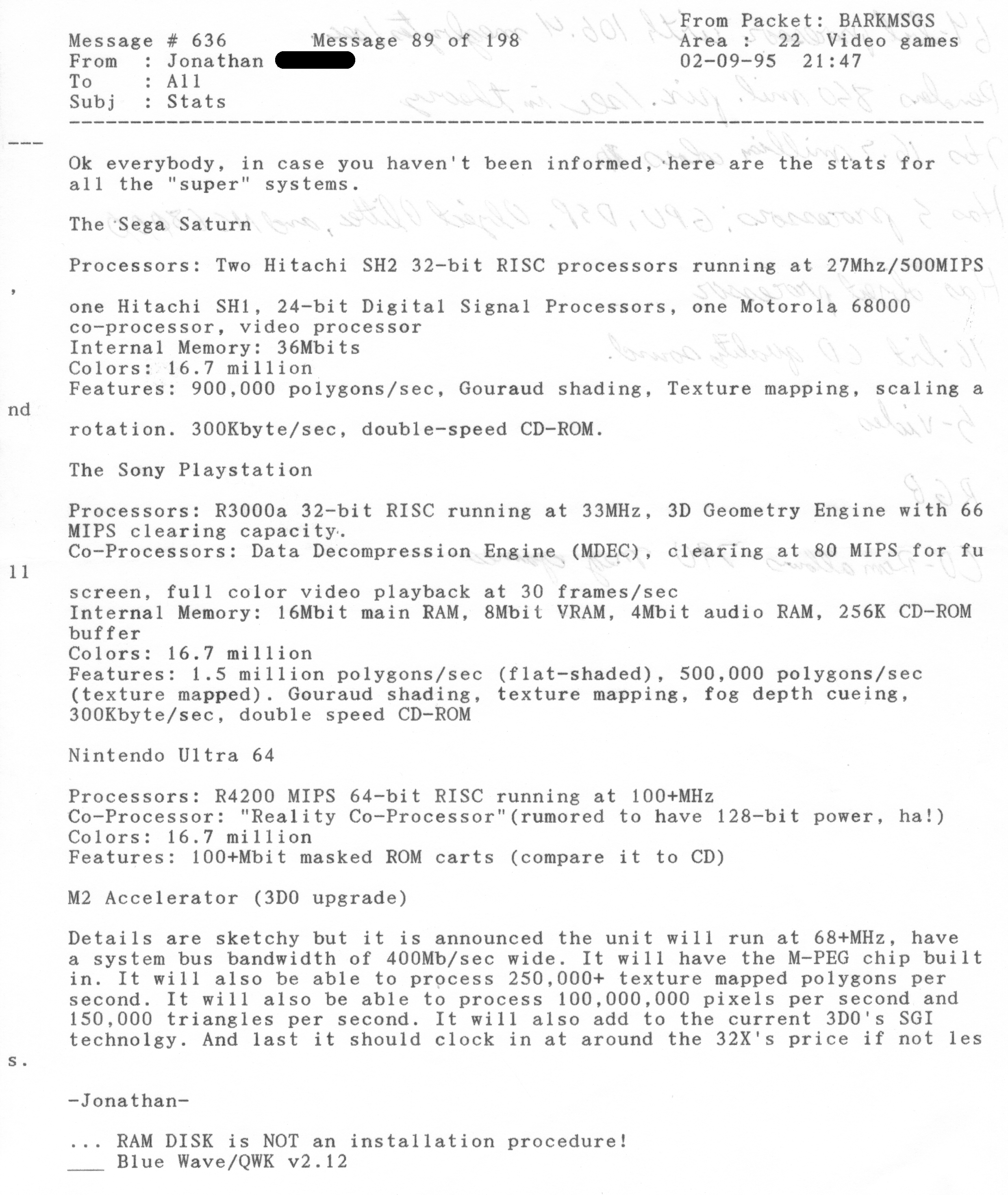
Aside from the BBS listings, all that I managed to keep from that time period were two two printouts of BARK messages that I downloaded at some point. Most likely, I printed these either to keep myself amused in a boring junior-high class, or to share them with a friend of mine who had similar taste in video games. Possibly both.
Random Acts of QWK
One of the few references to BARK you can find today is this Reedit post from a guy who claimed to have some QWK messages from BARK and was looking for help reading them. His post was a decade hence, but I messaged him on a whim and by some miracle of the Internet, he replied instantly and graciously gave me a copy to peruse. This filled in a lot of the gaps in my memory and I am eternally grateful!
BARK bulletin boards were called "Areas" and there were quite a few. If I had to guess, I would say there were probably Areas for fashion/clothing, skateboarding, TV shows, movies, and whatever else a record company exec would assume teens were into at the time. The Main Board was much more active than any other Area.
To read QWK files, you need a program they called an "offline mail reader." There were many of these but Blue Wave was one of the most popular and is proper old-school shareware. I remember using it, but I may have switched to something else later. Page 27 of Boardwatch from December 1992 mentions it in a list of offline mail readers. There were versions for MS-DOS on 8086/8088, for the 80386 (higher memory), and OS/2.
To get it going, I fired up a copy of DOSBox-X and went through the process of installing Blue Wave, pointing it at PKZIP version 2.04g, and copied the QWK messages into the DOWN directory. Here's what you're greeted with when you fire it up:
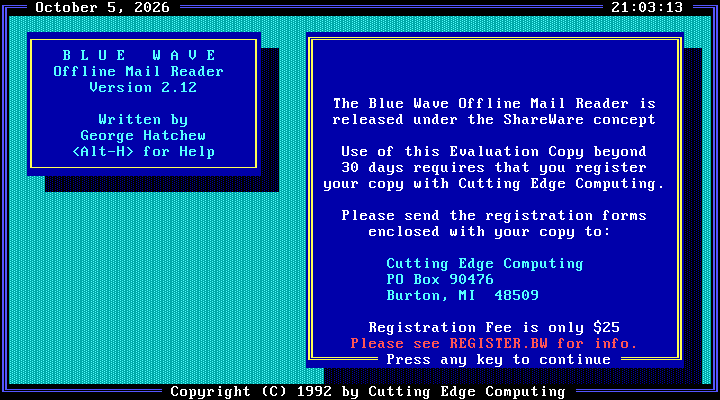
After 10 seconds of being forced to read the nag screen, it beeps and drops you at the main menu (the inverted block at the top of the screen is my mouse cursor):
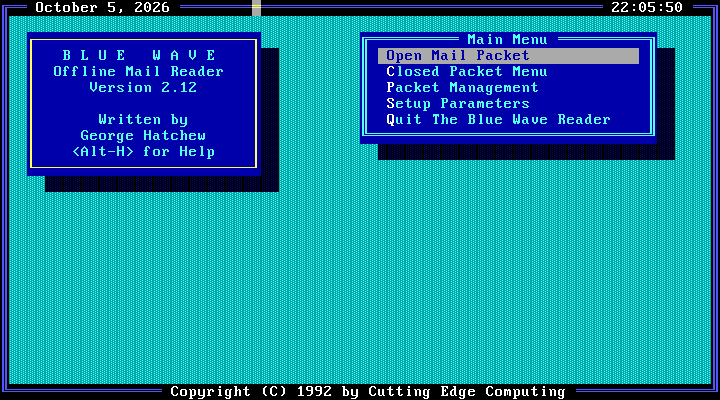
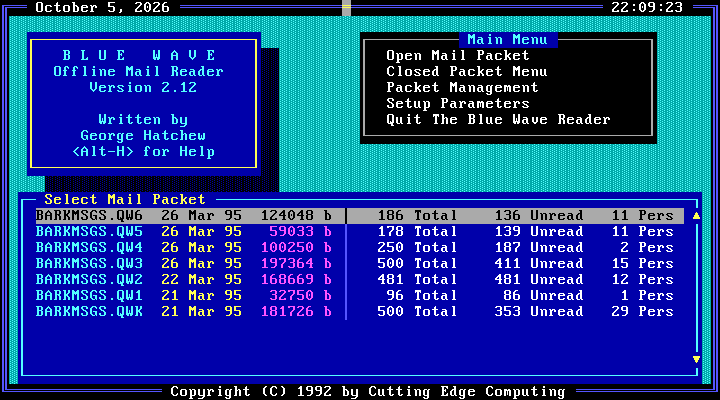
From here, we select which QWK file ("mail packet") to open:
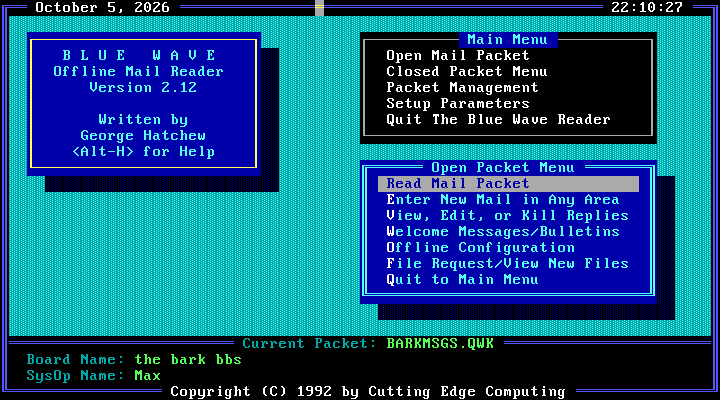
Once you open a packet, you're at the Packet Menu:
And then you're at the Area selection screen:
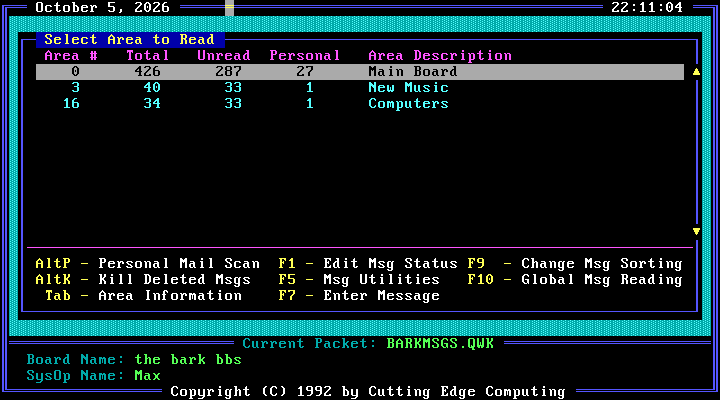
The QWK packet was assembled for you by the BBS software on-the-fly, so it knows who you are and thus can tell which messages were addressed to you. These are marked as "personal" messages by the mail reader. I don't remember if BARK supported non-public messages at all, but in this case, all messages are public even when addressed to another user. So "personal" in this case just means "public messages addressed to you. There's really nothing else special about them.
Blue Wave has all kinds of options for viewing and managing messages. You can mark a message for deletion and the "kill" it (delete it) later, mark it read, sort the messages any way you want, etc. I never got too fancy with any of the reader options, I'm sure I just read through whatever was new, replied to a few, and then just deleted the old QWK files when done with them.
Fun fact: Blue Wave has a "Boss Mode." If you press Alt+B, it blanks the screen and shows a C:\> prompt. This is of course hilariously useless because you can't even type anything into this screen. And Alt+D swaps you out to a real DOS prompt anyway...
Once you selected the Area to read, you were (finally) presented with a message list. Most BARK users used their real names so to avoid doxxing anyone, I've removed all last names from the following screenshot (except for Cheese Girl, I guess she gets to fend for herself):
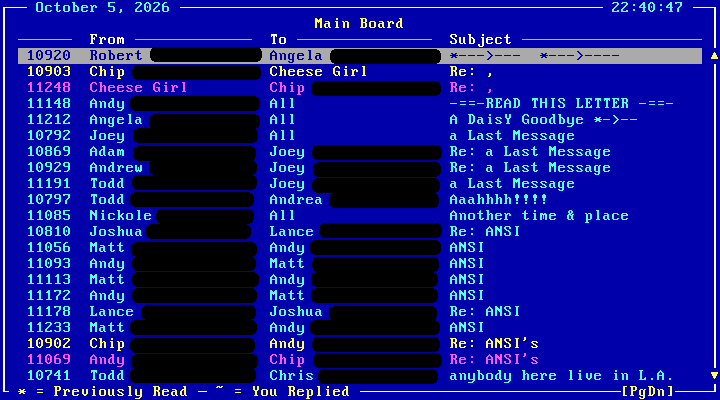
The first column is the message ID, I don't know if they wrapped around or what. You could sort on any of these fields, but unsorted (presumably the order in which they appear in the QWK file) was the default. For some reason, sorting by message ID or date isn't an option. I notice that subjects are typically grouped together but other than that, I can't tell how the messages ended up in the order they did. Maybe some quirk of the BBS software.
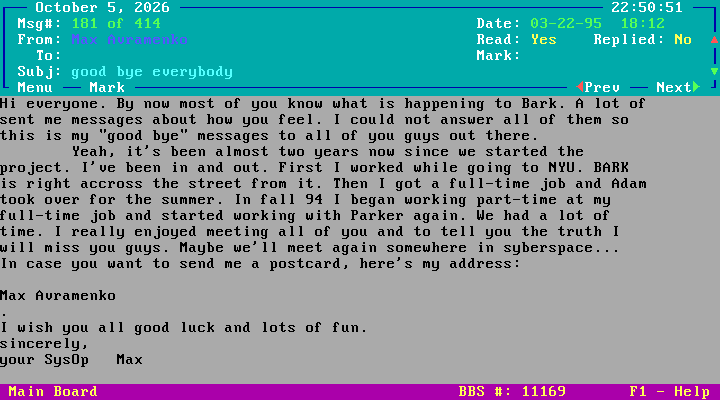
Finally, reading the message. The QWK files I was given contained messages from the last few days of BARK, including a sign-off from the Sysop, Max. (I removed his address and shifted the last few lines up to fit it all in one screen.)
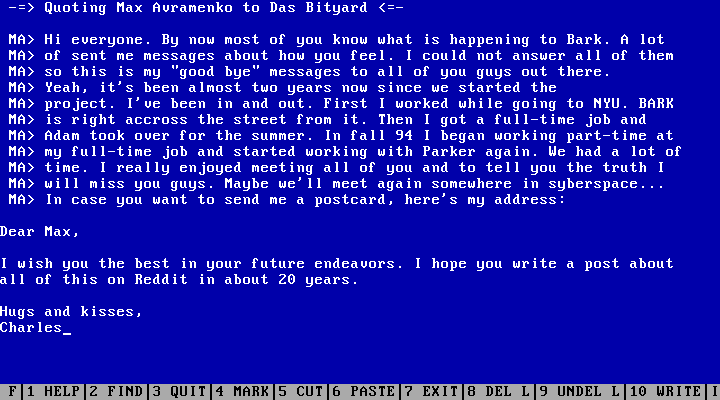
If you wanted to reply to a message, you were dropped into a basic text editor that came with Blue Wave called TED3.EXE, but you could tell it to use any editor you wanted.
Some people might ask why I'm not putting these last-known BARK messages online. Believe me, I'd like to, but there are several things holding me back:
- They're not actually mine to share, they belong to someone else. His (likely real) name and messages are in them. It would be like putting someone else's email folders online.
- There are thousands of messages here, almost all have some personal information, and I don't have the time or desire to sanitize all of them. And I definitely don't trust AI to do an adequate job. Lots of people put their phone numbers and addresses in their signatures, even more so when they found out that BARK was shutting down, in the hopes of staying in touch with friends they met there.
- Most of the messages are just not very interesting! More than half the messages are reactions, rants, flames, and unfortunately more than a few homophobic insults.
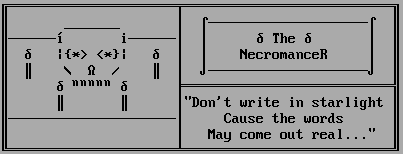
But here are a few of the more interesting signatures I ran across while reading some of the old messages:





All Good Things...
(Yeah, that's a TNG reference. Deal with it.)
BARK was fun while it lasted, and I tried to make the best of the other toll-free BBSes that were still around. But none of them had the vibrant community of BARK. As stated earlier, most toll-free BBSes were set up for very specific purposes and didn't tolerate a bunch of teenagers calling in and engaging in what might be very charitably called digital loitering. In fact, a good many of them locked their doors to new users due to the sheer number of BARK refugees trying to find a new toll-free home. I resurrected my 800-number dialing quest and kept at it for months, but never did find anything even in the same league until our household finally had real dial-up Internet access a couple years later.
I spent what was then widely considered an embarrassing amount of time on the Internet in the late 90's but never ended up hearing much about BARK at all. People would (and still do) reminisce about their pre-Internet BBS days, but BARK appears to have been almost entirely forgotten. That's what drove me to write this: I think it deserves to be remembered as the odd and improbable little oasis it was. There is precious little to remember it by, but I still consider BARK to be the first real online community I was a part of. So this is me, doing my best to make sure it doesn't fade into complete and total obscurity. If any other BARKers come across this, do feel free to contact me and I'd be happy to add your memories and contributions to this page.
Miscellany
Everything in this section consists of random thoughts and footnotes that didn't fit well into the sections above. If you feel like you got the story you wanted, please feel free to close this tab guilt-free.
BARK is not an acronym and doesn't seem to actually mean anything apart from being a snazzy name dreamed up by someone in Polygram marketing who thought it would resonate with the younguns of the day. Here's the trademark filing.
The guy who managed (and for some time, probably ran) BARK was Parker Reilly. He's apparently had an interesting career around music and media, most of which I learned from his bio on Solfege.tv. His band "The Sons" had one of their songs in the movie Dumb and Dumber. Which seems extremely appropriate as I was a huge Jim Carrey fan at the time. According to his LinkedIn page, he's had a number of other music/media-adjacent projects and companies since BARK.
You can read about the history and conclusion of PolyGram on Wikipedia but what's really interesting is that the PolyGram US web site is still online and is quite the delightful (if somewhat broken) 1990's web time capsule. Although maybe "time capsule" is too harsh, someone (maybe an LLM) has been adding what seem to be SEO-optimized, verbose but content-free articles like Best Concerts of 2025: Overview with the site's original CSS.
If you want to go deeper into finding more BBS lists (including toll-free ones), you might have luck digging through various popular FTP/HTTP mirror sites of the time on archive.org from the mid 90's, or trolling through postings on alt.bbs.lists Usenet archives from that period as well.
Other than the toll-free BBS lists, I didn't keep much digital data from that frame because I was not a data hoarder and durable physical media was not cheap. However, among the few scraps of paper I managed to keep, I found out:
- In 1996, one of the toll-free BBSes must have offered free email accounts with an
@access.govaddress, because I have a printout of some messages sent back to me by an FTP-by-email gateway at[email protected](and/or[email protected]?). So that would be first real Internet email address I had. The domain does not appear to exist anymore. - I also have a printout of a tutorial about how to find and download files entirely over email. It's called "SNARFING FILES BY MAIL" and describes how to search for and download files from the Internet, which was almost certainly what I was attempting to do with my fancy @access.gov email address. Unfortunately, the header of the file was mangled by accidental over-printing, so I can't quite make out the author.
I do remember somewhere in this time frame being able to access limited parts of the Internet through these toll-free BBSes. I'm sure I was able to access Gopher and at least one early text-based World Wide Web browser which was almost certainly Line Mode Browser.
If this kind of thing interests you, do be sure to check out Jason Scott's BBS Textfiles which includes all kinds of text files found on BBSes from the 80s and 90s. Including about a dozen other toll-free BBS listings. And you may even want to check out Jason's movie, BBS: The Documentary.
Other fun BBS-related links that I ran across while researching this:
- https://www.ipingthereforeiam.com/bbs/
- https://www.bbsing.com
- https://mirrors.archeobits.com
- https://nfbnet.org/download/ - This site is kind of broken, but if you mess with the domain while browsing around, there is quite a lot of MS-DOS and BBS-related software that you would have found on BBSes back in the day.
- https://wmcbrine.com/MultiMail/ - A "modern" QWK (and other offline mail) reader, which looks to have been significantly inspired by Blue Wave. No Linux packages provided, but it's packaged for Debian Trixie for some reason!
+++ATH0
NO CARRIER